

Fast Hiring in India Without Setting Up a Local Entity
Setting up your own entity in India before you can legally hire someone usually takes months, registration, local banking, tax setup, before a single offer letter goes out. With an Employer of Record, that timeline collapses dramatically.
An EOR is already the legal employer on the ground in India. That means the compliance groundwork is already done before you ever make an offer, so hiring becomes a matter of days and weeks, not months.
For companies that just need to get someone working in India now, that difference in speed is often the deciding factor in how they choose to enter the market.
It’s a straightforward trade: give up some of the long-term control that comes with owning your own entity, in exchange for a hiring timeline measured in days instead of months.
Key Takeaways
- Hiring through an Employer of Record (EOR) significantly reduces time to hire by eliminating the need to establish your own legal entity before employing staff in India.
- An EOR manages local employment compliance, including contracts, payroll, and statutory requirements, allowing new hires to start in days or weeks instead of months.
- Faster hiring helps secure top talent, reducing the risk of losing qualified candidates during lengthy entity setup and administrative processes.
- An EOR provides a scalable hiring solution, enabling companies to add their first and subsequent employees in India without repeating complex setup procedures.
- Companies can use an EOR as a market entry strategy, then establish their own Indian entity later if long-term expansion makes direct employment more practical.
Where the Time Actually Goes
If you set up your own entity first, most of the delay isn’t in finding a candidate. It’s in everything that has to happen before you’re legally allowed to employ anyone, including business setup and compliance support, such as business registration, opening a local bank account, setting up statutory compliance registrations, and more.
None of that is quick in India, and most of it has to happen before a new hire can even start, regardless of how fast you found them.
An EOR sidesteps that sequence entirely. Since Asiacruit is already registered and compliant in India, none of that setup time sits between you and your new hire.
It’s worth being clear-eyed about this trade-off. Building your own entity gives you a permanent, fully owned presence eventually. An EOR gives you speed now, at the cost of that long-term ownership structure.
What the Timeline Looks Like With an EOR
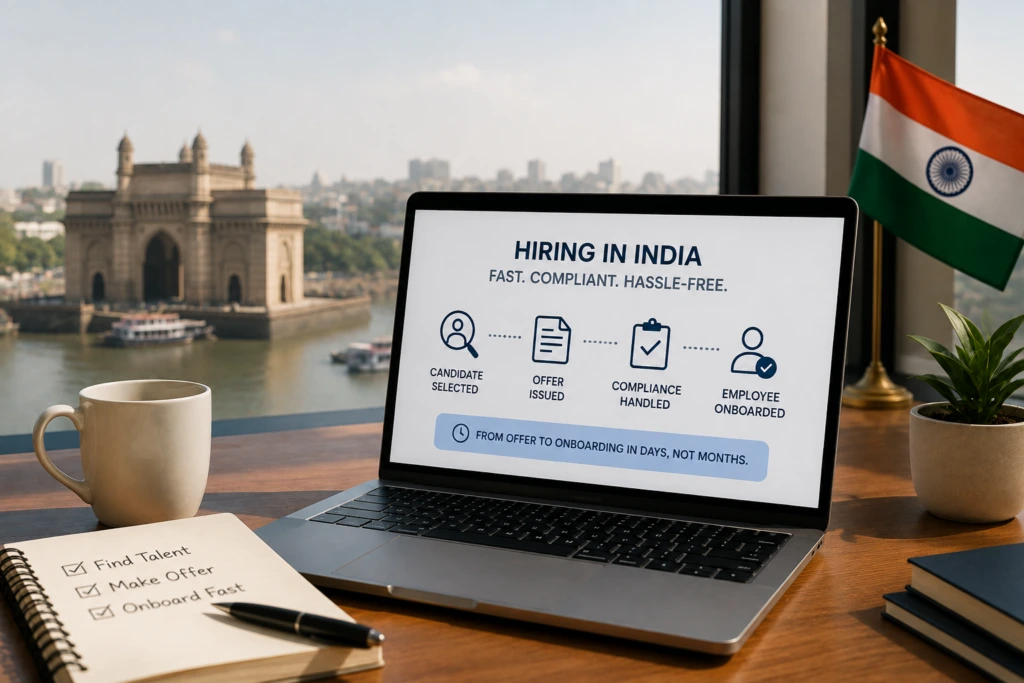
Once you’ve identified who you want to hire, the EOR process moves in parallel with, rather than after, your hiring decision. Contracts, statutory registrations, and payroll and compliance administration happen on Asiacruit’s side while you finalize the offer.
Most EOR hires in India can go from signed offer to a working start date in a matter of days, not the months a fresh entity setup would require.
That timeline holds up even for your first hire in India, when there’s no existing infrastructure to lean on yet. The compliance groundwork is already there because it belongs to the EOR, not to you.
Why Speed Matters More Than It Seems
A slow hiring timeline isn’t just an inconvenience. Strong candidates in competitive markets don’t wait around for a company to finish its entity paperwork. A multi-month gap between offer and employee onboarding coordination and start date is a real risk of losing the person you wanted.
It also affects how quickly your India operations can actually contribute. Every month spent on entity setup is a month where your India plans exist on paper but not in practice.
Speed compounds too. Your second and third hires move just as quickly as your first, since the compliance foundation is already in place.
That consistency matters as much as the initial speed. A hiring process that stays fast as you scale is worth more than one that’s quick once and slows down after.
It’s a difference you feel most once you’re on your third or fourth hire, when a slower process would have already started to drag on your momentum.
When This Matters Most
This speed advantage matters most when you’re testing the Indian market, responding to a time-sensitive opportunity, or simply don’t want your expansion timeline held hostage by paperwork. Faster market entry solutions help businesses move forward efficiently while reducing unnecessary delays.
If you’re confident you’ll be building a large, permanent presence in India regardless of cost or timeline, your own entity might eventually make sense. But for most companies making their first move into India, the time an EOR saves is hard to justify giving up.
The two paths aren’t mutually exclusive either. Plenty of companies start with an EOR to move fast, then revisit entity setup later once their India presence has proven itself.
Ready to Hire in India Without Waiting Months for Entity Setup?
Hire in India without the entity timeline.
Asiacruit’s Employer of Record service lets you hire full-time employees in India quickly and compliantly, without setting up your own entity first.
Frequently Asked Questions
How long does it take to hire someone in India through an EOR?
Most EOR hires in India move from signed offer to a working start date in a matter of days, not the months a fresh entity setup would require. The compliance groundwork is already in place because it belongs to the EOR, not to you.
Do I need to already have a registered entity in India to use an EOR?
No. That’s the core advantage of the EOR model. An EOR is already the legal employer on the ground in India, so you can hire without setting up your own business registration, local banking, or statutory compliance registrations first.
Can I switch from an EOR to my own Indian entity later?
Yes. Many companies start with an EOR to move fast, then set up their own entity later once their India presence has proven itself. The two approaches are not mutually exclusive.
Does hiring speed still hold up for my second or third hire in India?
Yes. Once the compliance foundation is in place through the EOR, subsequent hires move just as quickly as the first, since there’s no repeated entity setup process to work through.