

An employer of record (EOR) is a company that legally employs your staff in a country where you have no entity, You still direct their daily work. Most founders encounter this term for the first time when they try to hire someone abroad. In that country, their business has no legal presence. They find a great candidate in the Philippines or Indonesia and want to move quickly. Then someone in the finance or legal team asks: how do we actually employ this person without a local company?
That is exactly what the employer of record model was designed to solve. This guide explains what it is, how it works in practice, what you should expect to pay, and when it genuinely makes sense versus other options.
The straightforward definition
An employer of record (EOR) is a company that employs workers on behalf of another business. When you use one, the EOR becomes the legal employer of your staff in that country. They handle the employment contract, payroll, tax withholding, statutory contributions, and everything else that comes with being an employer under local law. You keep full control over who the person works for and what they do day to day. The EOR handles the legal layer underneath.
Here is a concrete example that makes it easier to understand. Say you run a company in the UK and you want to hire a finance analyst based in Manila. You have found the right person. Now you need to pay them legally and deduct the correct Philippine taxes. You must remit SSS, PhilHealth, and Pag-IBIG contributions on schedule. You also need a DOLE-compliant employment contract, and you must pay the statutory 13th month bonus by December 24. If you do not have a Philippine company, you cannot do any of that directly.
An employer of record like Asiacruit already has that Philippine legal entity. They employ the analyst and run the payroll in Philippine pesos. They handle all the compliance, and they charge you a management fee on top of the worker’s total compensation. Your analyst starts within days. If you want to see how this works for a specific country, our guide on how to hire employees in the Philippines covers the full detail of what is involved.
How the three-party arrangement works
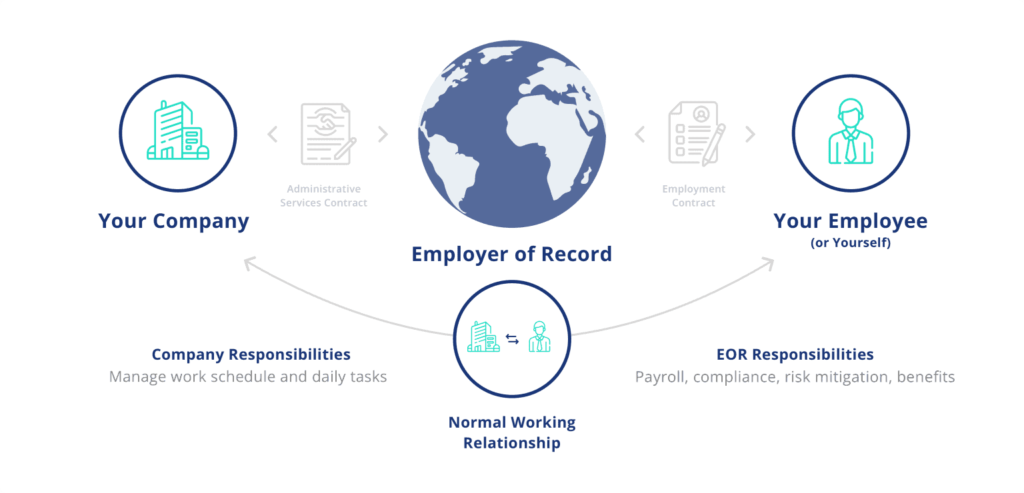
There are always three parties involved: the worker, the EOR, and you as the client company. Each plays a different role, and understanding the distinction matters.
The worker signs an employment contract with the EOR. Legally, the EOR is their employer. Their payslip comes from the EOR. All their statutory registrations and benefits flow through the EOR. The EOR holds all of the employer liability in that jurisdiction. They have a registered entity. They file the taxes and remit contributions to the relevant government agencies. They are also the party responsible if something goes wrong from a compliance standpoint.
You, as the client, manage everything operational. The worker reports to your team, does your work, follows your processes. You decide their responsibilities, their hours, and their performance expectations. From a practical standpoint, they are your employee in every meaningful sense. They just sit on the EOR’s books from a legal standpoint.
Commercially, you pay the EOR a consolidated amount that covers the worker’s gross salary, all statutory employer contributions, and the EOR management fee. The EOR handles every disbursement and filing on the other side.
What an employer of record actually covers

A full-service EOR takes on the entire employment infrastructure for your hired worker. That covers everything from contracts and payroll to statutory filings and offboarding. Here’s what that includes in practice.
Employment contracts

The EOR drafts contracts that comply with local labor law. In the Philippines, this means contracts that correctly specify probationary periods — capped at six months — reflect DOLE requirements, and include the right termination provisions. The client reviews the commercial terms of the role. The EOR makes sure the legal wrapper is correct.
Payroll in local currency

The EOR processes payroll on the agreed cycle in the local currency. It calculates all statutory deductions and pays the net salary directly into the worker’s bank account. For Philippine hires, that means handling BIR withholding tax, SSS, PhilHealth, Pag-IBIG, and the 13th month pay accrual throughout the year.
Statutory contributions and tax filings

Every country has its own employer contribution obligations and filing deadlines. In the Philippines, SSS employer contributions are currently 9.5 percent of the monthly salary credit. PhilHealth runs at a combined rate of 5 percent split equally between employer and employee. Pag-IBIG contributions vary by compensation level. The EOR tracks all of these, remits on schedule, and ensures the client company has no direct tax exposure in the jurisdiction.
Benefits and leave administration

The EOR ensures statutory benefit minimums are met. In the Philippines, regular employees are entitled to at least five days of service incentive leave per year under the Labor Code. Night differential premiums apply for work between 10 PM and 6 AM. Public holiday pay rules are specific and frequently missed by foreign employers. The EOR manages all of this.
Onboarding and offboarding

When a hire starts, the EOR registers them with the relevant government agencies and ensures every compliance requirement is met from day one. When employment ends, the EOR handles final pay calculations, clearance procedures, and any separation pay obligations that apply. In the Philippines, redundancy-related separation pay is one month’s basic salary per year of service. Getting this wrong is expensive.
Employer of record vs setting up your own entity
Companies almost always reach a point where they must decide. Should they run hires through an EOR, or set up their own entity in the market? The honest answer depends on how many people you are hiring and how long you plan to stay.
What entity registration involves
SEC registration, BIR registration, local government permits, and ongoing annual obligations including audits and regulatory filings. The process takes three to six months, requires local accounting support, and adds fixed overhead regardless of headcount.
None of that is prohibitive if you are building a long-term operation. But the EOR model often fits better in some cases. You might be hiring your first two or three people. You might be testing whether the market works. Or you may not want to run a foreign subsidiary right now. In each case, an EOR costs less in time, money, and management overhead.
EOR versus PEO: what is the difference
People sometimes use these terms interchangeably. They are not the same thing.
A professional employer organisation (PEO) operates on a co-employment basis. Both the PEO and the client company are recognised employers of the worker. PEOs manage HR administration and benefits, but the client company typically needs to already have a legal presence in the jurisdiction for the arrangement to work. This model is most common in the United States. There is a full breakdown of how employer of record versus a PEO works in the Asia context in our comparison post, but the short answer is this: if you are a foreign company with no entity in the worker’s country, a PEO does not solve your problem. An EOR does.
When does using an EOR actually make sense
Not every hiring situation calls for it. These are the scenarios where it is consistently the right move.
- You want to hire in a country where you have no registered entity and are not ready to set one up.
- You have found a strong candidate and need to move faster than an entity registration allows.
- You are entering a new market and want to test whether the hire works before making a longer structural commitment.
- Your headcount in the market is small enough that the fixed cost of running a local entity does not make sense.
- Your internal team does not have the bandwidth or expertise to manage foreign payroll, statutory filings, and labor law compliance in-house.
- You have had a compliance issue or close call with a misclassified contractor and want to move to a clean, defensible employment structure.
For companies building teams in Southeast Asia or South Asia for the first time, these conditions almost always apply.
What does it cost
EOR pricing typically takes one of two forms: a flat monthly fee per employee, or a percentage of gross salary. Most providers in the market charge between USD 300 and USD 600 per employee per month. Asiacruit’s fee is a flat USD 199 per month per employee, significantly lower than the industry range. There are no hidden percentage markups.
On top of the EOR fee, you are paying the worker’s gross salary and the statutory employer contributions required by local law. In the Philippines, employer-side contributions add approximately 12 to 14 percent on top of gross salary when you total up SSS, PhilHealth, and Pag-IBIG.
Companies consistently find the total cost competitive when they factor in the alternative properly. Entity setup in the Philippines typically costs USD 3,000 to USD 8,000 in legal fees upfront, plus ongoing accounting, audit, and compliance costs every year regardless of headcount. The EOR fee covers all of that in a single transparent line item.
Employer of record in Asia
Asia is not one market with one set of rules. The Philippines, Indonesia, India, and Vietnam each have different labor codes, contribution frameworks, termination rules, and administrative requirements. The variation between markets is significant.
13th month pay in the Philippines is mandatory under Presidential Decree 851. It is not a bonus. Missing the December 24 deadline is a compliance violation. Indonesia has its own mandatory allowance structure under the Manpower Act. India operates under a patchwork of central and state-level legislation that changes depending on where your worker is based.
Asiacruit operates as an employer of record in Asia built specifically for these markets. Our compliance team works across the Philippines, Indonesia, and India every day rather than covering every country globally with a checklist approach. For a full breakdown of how we structure employment in the Philippines specifically, see our employer of record Philippines service page.
Frequently asked questions
No. The EOR is the legal employer but you run the working relationship. You set the role, manage the person’s daily responsibilities, decide their targets, and make decisions about their performance and compensation. The EOR manages the legal and administrative employment layer in the background. Your employee works for your business. They just sit on the EOR’s payroll and legal structure.
Yes. EOR is a recognised and widely used employment structure across Asia and globally. EOR providers operate as registered employers in their target markets and comply fully with local employment law. The model is used by companies ranging from early-stage startups to publicly listed multinationals. Asiacruit is a registered employer in its operating markets.
In most cases, five to fifteen business days from the point the offer is agreed. That includes issuing the employment contract, registering the worker with statutory agencies, and getting payroll set up. Compare that to three to six months for entity registration. The speed difference is one of the most tangible reasons companies choose the EOR route, particularly when competing for candidates.
Most EOR providers support a transition process when clients decide to set up their own local entity. The worker’s seniority, benefits history, and employment continuity are typically preserved in the move. If you know from the start that you plan to set up an entity eventually, mention it at the outset so the employment terms are structured in a way that makes the transition clean.
Outsourcing means contracting a third party to deliver a service or function, where that third party manages the staff involved. You are buying a service. An employer of record is different because you manage the worker directly yourself. The EOR is handling the employment structure, not the work output. The worker is part of your team in every operational sense. They just happen to be employed through the EOR’s legal entity in their country.
The EOR model is designed for employment relationships, not short-term project work. If you need a freelancer for a defined project with a clear end date and no ongoing employment relationship, a contractor arrangement is more appropriate. If you want to hire someone on an ongoing basis with the protections and obligations of employment, that is what the EOR covers. A good provider will tell you clearly which structure fits your situation.
Ready to hire in Asia?
Hire without setting up a local entity
See how our employer of record Philippines service works, or book a free consultation with our team.
Related Reading
- How a SaaS Startup Hired a Philippines Dev Team in 2 Weeks
- Offshore Talent Acquisition
- BPO Services in the Philippines
- Payroll Management Philippines
- How to End Employment in the Philippines Without Violating Labor Law
- Employer of Record Indonesia: Hire Without a Local Entity
- Employer of Record India: Compliance, Costs, and How It Works
- Philippines Contractor vs Employee: The Classification Mistake That Costs Thousands
- Talent Solutions in the Philippines: What’s Included
- How Fast You Can Actually Hire in India With an EOR
- Employer of Record Philippines: Hire Fast, No Entity Needed
- Deel Alternatives for Hiring in the Philippines, Indonesia and India (2026)